BROOKS
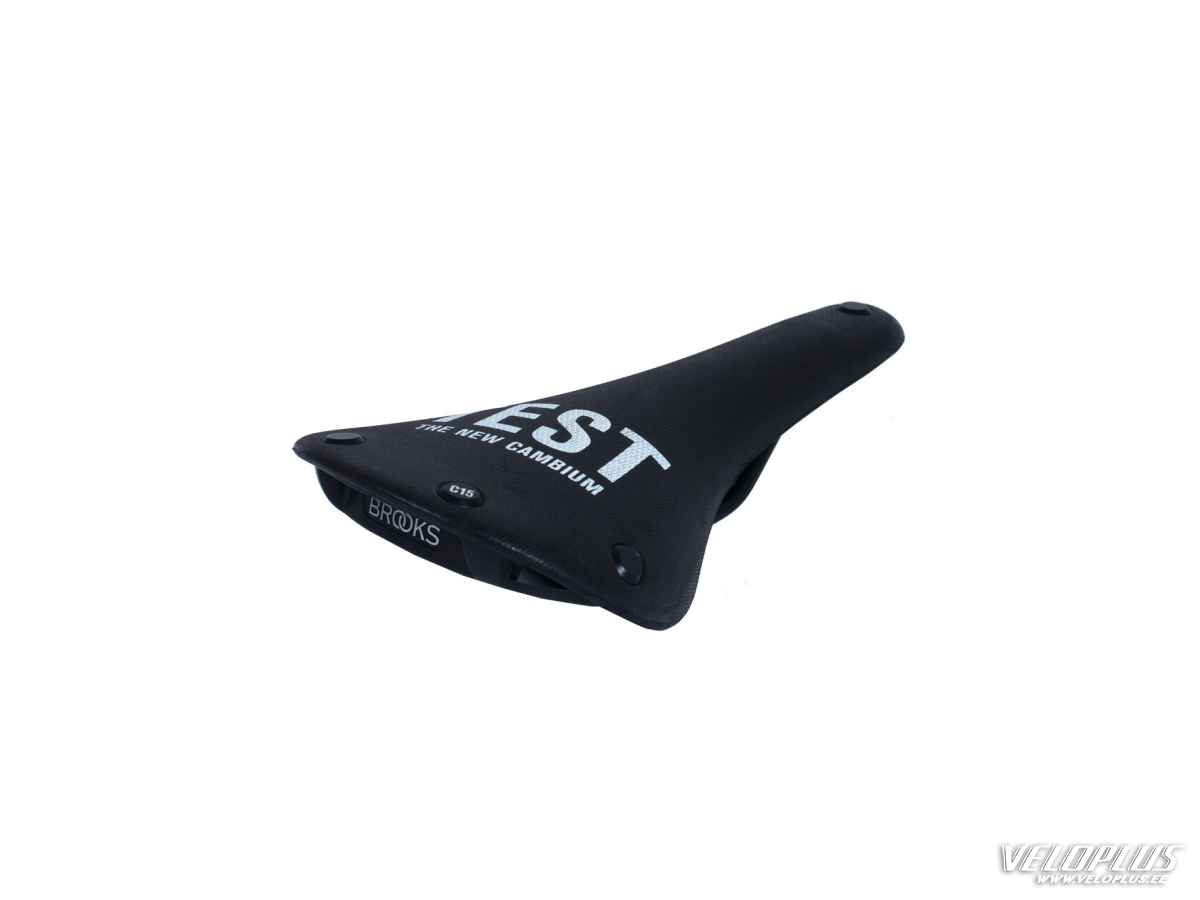
Saddle BROOKS CAMBIUM C15 TEST black
Saddle BROOKS CAMBIUM C15 TEST black
Black saddle with white TEST lettering
- Dimensions: L 283 x W 140 x H 52 mm
- Weight: 432g
- Riding position: Forward riding position
The Cambium C15 Carved is a saddle with a hole designed for pressure relief. Ideal for bikepacking, commuting, gravel, and cycle touring thanks to its extra-flexible vulcanized-rubber top, this saddle offers all-day performance and weather protection. Suitable for the forward riding position, the C15 Carved is ideal for long journeys and ultra-endurance cycling events, as well as urban cycling. The best bicycle seat for everything from racing to casual adventure, the C15 Carved is ready to ride in all weathers and on all roads, requiring no break-in period.
Backplate loops can sustain a 3kg max load, please select a saddle bag accordingly.
IDEAL FOR:
- Commuting in the city
- Road cycling
- Traveling the globe
- Gravel & Bikepacking
- All weather conditions
Features:
- Pressure Relief & Added Flex
- Naturally Flexible Rubber
- Moves with you
- All-surface absorption
- Continuously comfortable
FEATURES:
- Vulcanized Natural Rubber Saddle Top
- Flexible and Robust Touring Surface
- UV + Abrasion-Resistant Waterproof Nylon Top
- Nose-piece and Saddle Plate in Fibreglass-Reinforced Nylon
- Durable, Anodized Aluminum Rivets
- Tubular Steel Rails with black powder coating
-
 Estonia
Free shipping
Estonia
Free shipping -
 Finland
Free shipping
Finland
Free shipping -
 Latvia
Free shipping
Latvia
Free shipping -
 Lithuania
Free shipping
Lithuania
Free shipping
BROOKS England is the legendary British bicycle saddle maker, founded in 1866 in Birmingham by John Boultbee Brooks — originally as a workshop for horse saddles and leather goods. The brand's origin story is one of the most charming in cycling history: in 1878 Brooks's beloved horse died, and he didn't have the money to buy a new one. He commuted to work on a bicycle borrowed from a friend, but the wooden saddle of the time was so uncomfortable that Brooks vowed to find a solution to the problem. The result came in 1882 — the first Brooks leather bicycle saddle patent. In 1888 the B17 model went on sale, and is still in production today as the brand's best-selling saddle — making it likely the longest continuously produced bicycle component in the world. Brooks saddles are still handmade in a brick factory in Smethwick on the outskirts of Birmingham, to which the company moved in the 1950s after the previous factory was bombed during World War II. A special detail: most of the machines in the factory also date from the 1950s — the production process was already so refined that there has been no need for new ones. When a machine breaks down, the parts are taken to a local metal workshop where new ones are made. Every classic Brooks saddle is made from a single piece of vegetable-tanned leather stretched over a metal frame, and through use it gradually takes on the shape of the rider's seat. The cherry on top: a well-maintained leather saddle lasts decades, and the factory has told the story of a 72-year-old man who returned a saddle he had been riding continuously since buying it as a 15-year-old. Today's Brooks is no museum: since 2013 the brand has also offered the Cambium collection — saddles made of organic cotton and vulcanised rubber that need no breaking in and no maintenance, while keeping the same classic silhouette. The range also includes high-quality leather bags, handlebar grips and bells — everything that turns a bike into a classic ride. Brooks was bought by Raleigh in 1962, regained its independence in 1999 after Raleigh collapsed, and since 2002 has belonged to Italy's Selle Royal group — but all production has remained in Birmingham. The Brooks philosophy is simple and entirely British: do things slowly, properly, from one good material — and they will last a lifetime.