
How to choose a bicycle for your child? A practical guide to finding the right kids’ bike
The right kids’ bike is not simply a smaller version of an adult bike. A child needs a bike they can control independently: start, stop, turn, lift and, when needed, touch the ground with their feet. If the bike is too large, too heavy or the brakes do not fit the child’s hands, cycling can quickly feel unstable. When the bike fits properly, confidence and the joy of riding develop much faster.
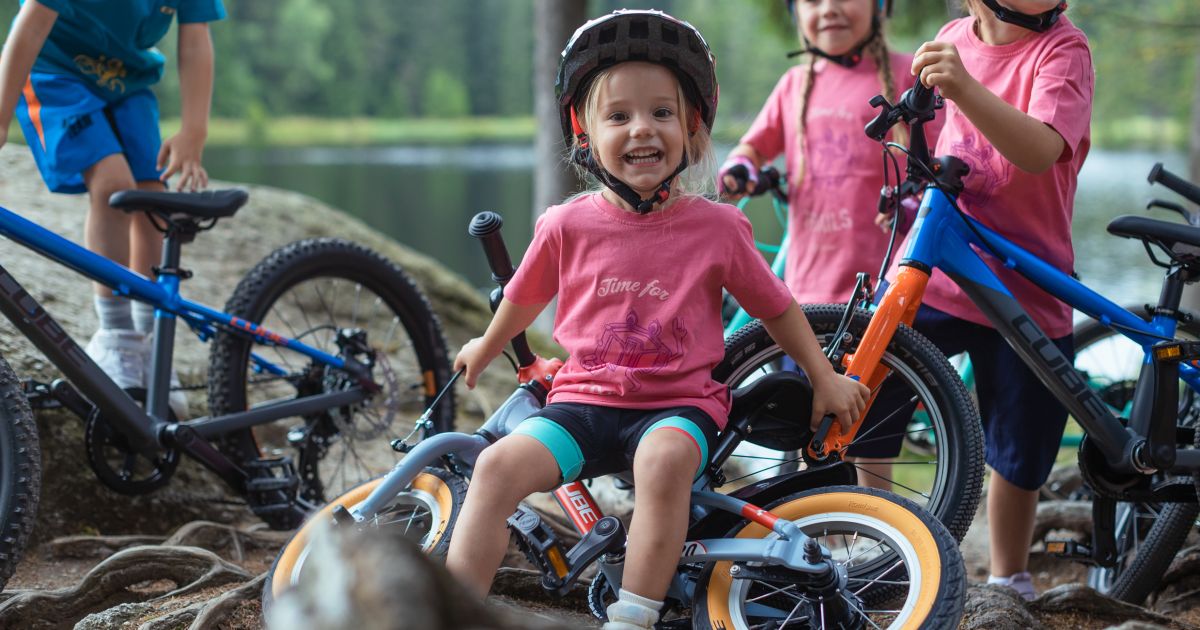
In Veloplus’ range of kids’ bikes, you will find bikes for small beginners, school routes, family rides and easier forest trails. You can choose by wheel size, rider height, brake type, gears, weight and brand; available brands include Woom, Merida, Cube and Kellys.
Start with measurements, not age
A child’s bike size should not be chosen by age alone. Children of the same age can differ greatly in height, leg length and riding experience. A more precise starting point is the child’s height and inseam measurement, meaning the distance from the crotch to the floor. When choosing a size, we recommend starting with height and inseam measurement; age should be treated only as an approximate guide.
To measure the inseam, ask the child to stand against a wall wearing shoes. Place a hard-cover book between the child’s legs as if it were the saddle during riding, mark the top edge of the book on the wall and measure the distance from the floor to the mark. Woom describes the same measuring method in its size guide.
Kids’ bike sizes: where to start?
Kids’ bikes are mainly differentiated by wheel diameter: 12”, 14”, 16”, 18”, 20”, 24” and 26”. On adult bikes, frame size is often the primary measure, but on children’s bikes the wheel size gives the first orientation. A size chart should also use wheel size together with the child’s height and inseam; common children’s bike sizes are 12–26 inches, and frame geometry may vary by manufacturer.
| Wheel size | Approx. child height | Min. inseam | Suitable for |
|---|---|---|---|
| 12” | approx. 86–102 cm | balance bike or first small bike | |
| 14” | approx. 94–109 cm | from 35.5–37.5 cm | transition from a balance bike to a first pedal bike |
| 16” | approx. 105–122 cm | from 43.5 cm | first proper kids’ bike for a more confident beginner |
| 18” | Kellys: 110–130 cm | transition from a smaller kids’ bike to a junior bike | |
| 20” | approx. 115–135 cm | from 50.5–56.1 cm | for preschoolers or younger schoolchildren, often already with gears |
| 24” | approx. 125–145 cm | from 57–62.5 cm | longer rides, school routes and easier forest trails |
| 26” | approx. 135–155+ cm | from 65.5–70 cm | older child or young rider moving towards an adult bike |
This table is the starting point for a purchase decision, not the final answer. For example, Kellys divides junior bikes by height: 16” models for 105–120 cm, 18” models for 110–130 cm, 20” models for 115–135 cm, 24” models for 125–145 cm and 26” models for 135–155 cm.
Do three fit checks in the shop
1. The child must be able to stand safely over the bike
The practical guidance from the Estonian Transport Administration is simple: a bike is the right size if the child can stand astride the top tube with both soles on the ground and at least a few centimetres of clearance above the frame. Another quick check is to stand next to the bike: the saddle should be roughly at hip height.
2. In the saddle, the child must be able to control the bike
For a beginner, it is especially important that the child can reach the ground securely while seated. A child who is learning should be able to put one foot down easily; for a complete beginner, it is safer if both feet can reach the ground.
3. Hands must reach the handlebar and brakes
Too long a reach — a handlebar that is too far away — makes the bike feel unstable. The child should be able to hold the handlebar with slightly bent elbows and pull the brake levers without overstraining the hands. Check both saddle height and reach to the handlebar. Brake levers must be reachable and easy for the child to press.
Do not buy a bike that is too large “to grow into”
The most common mistake is buying a bike that the child is supposed to grow into. A bike that is too large is harder to control at first, less stable and may make cycling feel difficult or frightening, which can reduce the child’s desire to ride altogether. Kellys’ kids’ and junior bike guide calls buying a bike that is too large the most common mistake and stresses that the child must be able to get on and off safely, reach the handlebar and brakes and stand firmly on the ground.
In terms of size, it is better to choose a bike that fits the child now, not in two years. On a quality bike, the saddle and often also the handlebar can be adjusted, but a frame or wheel size that is too large will not become safe through adjustment alone.
Weight matters more than adults often think
The weight of a kids’ bike is an important selection criterion. A couple of extra kilograms may seem minor to an adult, but for a child it affects starting, braking, turning, riding uphill and holding the bike upright. A practical rule is that a kids’ bike should weigh up to about 30–40% of the child’s body weight. Exceptions exist, but in general a lighter bike is easier for a child to handle.
A light, correctly sized kids’ bike makes riding much more fun. A bike that is too heavy can be proportionally as demanding for a child as an unreasonably heavy bike would be for an adult.
Simplicity for beginners, more options for experienced riders
For a first bike, the aim is not to have as many gears, suspension parts or accessories as possible. The aim is for the child to learn balance, braking, turning and attentiveness in traffic. A single-speed bike is simpler for a beginner because the child can focus on pedalling, balance and learning.
A more experienced child who already rides longer distances, to school, on gravel or on forest roads may need gears, wider tyres and stronger brakes. This is where 20”, 24” and 26” junior bikes come in. For example, the Merida MATTS J.24 PLUS is a 24” model for riders 125–145 cm tall, with a 1x8 drivetrain, hydraulic disc brakes and wider plus-size tyres.
Brakes: the child must actually be able to use them
Brake type is less important than whether the child can use the brake in a controlled way. For a smaller rider, the brake lever must be close to the hand, easy to pull and intuitive. CUBE describes thinner grips, a smaller-diameter handlebar and adjustable brake levers that can be moved closer to the handlebar on its Numove kids’ models.
For a younger child, a simple and well-adjusted V-brake is a perfectly reasonable solution. For an older child who rides faster, further or off-road, disc brakes can offer better control, although they also add to the bike’s price.
Suspension is not always an advantage
With kids’ bikes, it is worth being critical of cheap and heavy suspension. If the child mainly rides on asphalt, in parks, to school or on cycle paths, a light rigid fork is often a better choice than a heavy entry-level suspension fork. We recommend being sceptical of cheap suspension fitted mainly for appearance: it adds weight and may worsen ride quality. For more serious off-road riding, a quality front suspension fork that can be adjusted to the child’s weight is more sensible.
What type of bike should you choose for a child?
First bicycle or balance bike
If the child is still learning balance, a balance bike is an excellent start. It teaches rolling, turning and balance before pedals. A balance bike is light and simple, with no pedals, cranks or chain, and helps the child learn balance and steering.
From 9 months of age, for example, the Woom WOW 0 is suitable. Our balance bike range also includes the Woom Go 1 and Kellys Kite.
Rides near home and the first pedal bike
Once the child can keep balance and is ready to pedal, a simple, light, single-speed 14” or 16” bike is a good choice. Low weight, easy-to-reach brakes, a low frame and simple handling are worth prioritising.
Good options here are Woom GO and Cube Numove models.
School routes and family bike rides
When the child rides more confidently, rolling efficiency, gears, a comfortable riding position and visibility become more important. 20” and 24” bikes often fit this stage. A 1x drivetrain can be preferable because it is easier for a child to understand than a system with multiple front chainrings.
Suitable directions: Woom GO/EXPLORE, Merida MATTS J.20 and J.24, Cube Acid or larger Numove models, and Kellys 20” and 24” junior bikes.
Gravel, parks, forest roads and sportier riding
If the child rides actively and also wants to leave asphalt behind, look at 20”, 24” or 26” bikes with wider tyres, more stable geometry and better brakes. For the CUBE Numove 240, CUBE highlights a light aluminium construction, low standover height, child-specific geometry, small pedals, short cranks and adjustable handlebar position.
Suitable directions: Merida MATTS J Plus, Cube Acid/Numove, Woom EXPLORE or OFF, Kellys NAGA/KITER junior models.
Helmet and visibility are not optional extras
In Estonia, a helmet is mandatory for children under 16. The Transport Administration stresses that a helmet only protects if it is the right size and correctly fastened; when buying a helmet, look for the CE EN1078 marking.
A technically safe bicycle must have working brakes, a bell, a white front reflector and red rear reflector, and yellow or white reflectors on both sides of at least one wheel. In the dark or in poor visibility, a white front light and red rear light must be on.
This means that when buying a child’s bike, it is worth thinking about accessories right away: helmet, bell, lights, reflectors, lock and, if needed, mudguards and school-route equipment.
You can find our helmet selection here; the filters also allow you to enter head circumference, so you can see the selection that matches that exact measurement.
Woom, Merida, Cube or Kellys — how to choose?
Woom is a good fit for families who prioritise low weight, child-specific geometry and learning-friendly handling. Veloplus’ Woom brand page describes Woom as an Austrian kids’ bike manufacturer whose bikes are designed with children’s size, weight, braking and riding position in mind.
Cube is a strong choice if you want a broad model range and child-specific ergonomics. On its kids’ models, CUBE emphasises grip diameter, a handlebar suited to smaller hands, adjustable brake levers, short cranks and pedals matched to the child’s height.
Merida is well suited to a child who already rides longer distances or on easier terrain. Merida MATTS J 20” and 24” models are aimed at young riders who need better rolling, gears, grip and more confident braking. The Veloplus Merida MATTS J.24 PLUS example combines 24” wheels, 1x8 gears, hydraulic disc brakes and a 125–145 cm rider height range.
Kellys is a practical choice if you want junior bikes clearly divided by height. Kellys’ own guide stresses that the bike must fit now, not in the future, and that size, weight, controllability, build quality and riding style should be considered when buying.
Quick pre-purchase checklist
Before buying, ask these questions:
- Do the child’s height and inseam match the range of the specific model?
- Can the child stand over the bike with feet firmly on the ground and clearance above the top tube?
- Is starting and stopping secure when sitting in the saddle?
- Can the child reach the brake levers without strain?
- Is the bike light enough for the child to control independently?
- Are gears, suspension and accessories necessary for the child’s actual riding style?
- Are the helmet, lights, reflectors and bell in place?
Summary
The best kids’ bike is not necessarily the biggest, most expensive or best equipped. The best kids’ bike is the one the child can use confidently right away. The right size, low weight, brakes suited to a child’s hands and equipment matched to riding skill give the child confidence. When the child feels that the bike responds to them, the joy of riding follows.
At Veloplus, you can choose Woom, Merida, Cube and Kellys kids’ bikes by child height, wheel size, brake type, gears and riding style. Measure the child’s height and inseam before buying, test the fit and choose a bike the child can ride confidently today.